Japan’s onsen tattoo ban is one of the biggest headaches for tattooed travelers. Most traditional public baths still prohibit tattoos entirely – a policy rooted in the historical association between tattoos and yakuza. But things are changing, especially in Hokkaido where international tourism has pushed more facilities to relax their rules.
In This Article
- The Quick Answer
- How Tattoo Policies Work in Japan
- Tattoo-Friendly Onsen in where to stay in Sapporo
- Dormy Inn Premium Sapporo
- Tsukiura Onsen (Jozankei onsen guide)
- Private Onsen Rentals
- Tattoo-Friendly Onsen in Niseko
- Niseko Grand Hirafu Area
- Yukichichibu (Niseko area)
- Tattoo-Friendly Onsen in Noboribetsu onsen guide
- Dai-ichi Takimotokan
- Private Onsen Options in Noboribetsu
- Tattoo-Friendly Onsen in Hakodate
- Yunokawa Onsen Area
- Taisei-kan (Hakodate)
- Eastern Hokkaido
- Workarounds That Actually Work
- Tattoo Cover Patches
- Private Bath Rental (Kashikiri-buro)
- Book a Room with an In-Room Onsen
- Go at Off-Peak Times
- How to Ask About Tattoo Policies
- The Trend Is Positive
This guide lists onsen and public baths across Hokkaido where tattoos are explicitly welcomed or tolerated, plus practical workarounds for places that haven’t caught up yet. We update this regularly – if you find a place that’s changed its policy, let us know.
The Quick Answer
If you have tattoos and want to guarantee an onsen experience in Hokkaido without any hassle, your best options are:
- Book a hotel with a private onsen (called kashikiri-buro or family bath) – nobody checks, nobody cares
- Stay at a Dormy Inn – the chain is widely reported as tattoo-tolerant across Japan
- Use tattoo cover patches (available at most drugstores and convenience stores) for smaller tattoos at public baths
For everything else, keep reading.
How Tattoo Policies Work in Japan
There’s no law against tattooed people using onsen. It’s an internal policy that each facility sets independently. In practice, you’ll encounter three situations:
- Tattoos OK – No restrictions. Walk in, soak, enjoy.
- Tattoos OK if covered – Small tattoos can be covered with waterproof patches (sold at the reception or nearby). Larger tattoos that can’t be covered may still be refused.
- No tattoos – Staff will ask you to leave if tattoos are visible. This is still the majority of traditional public baths.
The trend is moving toward acceptance, especially in tourist-heavy areas. After the 2019 Rugby World Cup and ahead of future international events, the Japan Tourism Agency has actively encouraged onsen to accommodate tattooed foreign visitors. Hokkaido, with its large international ski tourism industry, has been quicker to adapt than most regions.
Tattoo-Friendly Onsen in where to stay in Sapporo
Dormy Inn Premium Sapporo
The rooftop onsen at this budget hotel chain is widely reported as tattoo-friendly. Staff don’t check and other guests generally don’t comment. The bath is small but proper – hot tub, sauna, and a cold plunge. Open to hotel guests only, which keeps it uncrowded.
- Location: 5-min walk from JR Sapporo Station
- Access: Hotel guests only
- Cost: Included in room rate (rooms from ~¥7,000/night)
- Type: Indoor onsen + sauna
→ Book Dormy Inn Premium Sapporo: Booking.com | Agoda
Tsukiura Onsen (Jozankei onsen guide)
About an hour from Sapporo by bus, Jozankei has several day-use onsen. Tsukiura Onsen is one of the more relaxed facilities in the valley. Check at reception before entering – policies can vary by staff on duty. The outdoor rotenburo here is worth the trip regardless.
- Location: Jozankei Onsen, 60 min by bus from Sapporo
- Access: Day visitors welcome
- Cost: ~¥1,000–¥1,500 day use
- Type: Indoor + outdoor baths
Private Onsen Rentals
Several Sapporo hotels offer kashikiri-buro (private bath rental) by the hour. You book a private room with its own onsen bath – no shared space, no policy issues. Hotels offering this include:
- Hotel Monterey Edelhof – natural hot spring, near Sapporo Station
- JR Tower Hotel Nikko – sky spa (though this is a shared facility; ask about private options)
- Various Jozankei ryokans – many offer rooms with private attached onsen
Tattoo-Friendly Onsen in Niseko
Niseko is probably the most tattoo-tolerant area in Hokkaido, thanks to its massive international visitor base. Australian, European, and North American skiers with tattoos are the norm here, and most facilities have adapted.
Niseko Grand Hirafu Area
Most hotel onsen in Hirafu are relaxed about tattoos. The international atmosphere means staff are accustomed to tattooed guests. Specifically reported as tattoo-friendly:
- Ki Niseko onsen – hotel guests, tattoos accepted
- Hilton Niseko Village onsen – generally tolerant, cover patches available
- Green Leaf Niseko Village – natural onsen, relaxed policy
Yukichichibu (Niseko area)
A rustic, slightly off-the-beaten-path onsen near Niseko that’s known for its relaxed attitude. The milky sulphur water and forest setting make it feel properly remote. Not the fanciest facility but one of the most authentic onsen experiences in the Niseko area.
- Location: South of Niseko, about 20 min by car
- Access: Day visitors welcome
- Cost: ~¥500–¥800
- Type: Indoor + outdoor, mixed-gender outdoor bath (towels OK)
Tattoo-Friendly Onsen in Noboribetsu onsen guide
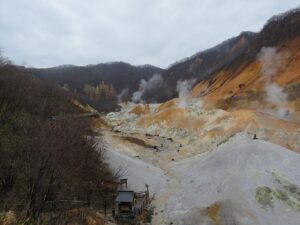
Noboribetsu is Hokkaido’s most famous onsen town, fed by the volcanic Hell Valley. As a major tourist destination, several facilities here have moved toward accepting tattoos.
Dai-ichi Takimotokan
One of Japan’s largest public bath houses with over 30 different pools. Their official policy has historically been no tattoos, but they offer cover patches at reception and enforcement varies. For small to medium tattoos that can be covered, you’ll likely be fine. Full sleeves are a harder sell.
- Location: Central Noboribetsu Onsen
- Access: Day visitors welcome
- Cost: ~¥2,250 day use
- Type: Massive facility – 35+ pools including outdoor
- Policy: Cover patches available. Call ahead if heavily tattooed.
Private Onsen Options in Noboribetsu
Several Noboribetsu hotels offer private baths:
- Bourou Noguchi Noboribetsu – luxury ryokan, rooms with private onsen
- Noboribetsu Grand Hotel – kashikiri bath available
- Mahoroba – private family baths for rent
Tattoo-Friendly Onsen in Hakodate
Yunokawa Onsen Area
The Yunokawa hot spring district in Hakodate has a growing number of tolerant facilities. The area sees significant international tourists visiting Hakodate for the night view and morning market.
- Yunokawa Prince Hotel Nagisatei – oceanfront onsen, generally relaxed policy for hotel guests
- Imagine Hotel & Resort – modern hotel, reported as tattoo-accepting
Taisei-kan (Hakodate)
A super sento (large public bath complex) in Hakodate that’s been reported as tattoo-friendly. These large commercial bath houses tend to be more relaxed than traditional ryokans. Multiple bath types, saunas, and rest areas.
- Location: Hakodate city
- Access: Day visitors
- Cost: ~¥500–¥800
Eastern Hokkaido
Smaller, rural onsen in eastern Hokkaido tend to be more traditional and stricter about tattoos. However, some notable exceptions:
- Kawayu Onsen (Teshikaga) – some guesthouses in this area are relaxed, especially those catering to international visitors
- Lake Akan area – some hotels with private onsen options
In general, the further east and more rural you go, the more you should ask before stripping down. A quick phone call or check at reception saves everyone an awkward moment.
Workarounds That Actually Work
Tattoo Cover Patches
Waterproof patches (called irezumi kakushi sheeto or tattoo cover seal) are available at:
- Most drugstores (Matsumoto Kiyoshi, Sapporo Drug Store)
- Don Quijote discount stores
- Some convenience stores near tourist areas
- Some onsen reception desks
They work well for tattoos up to roughly 15cm x 20cm. They’re skin-coloured, waterproof, and surprisingly convincing. For multiple small tattoos, buy several patches. For full sleeves or large back pieces, patches aren’t practical.
Private Bath Rental (Kashikiri-buro)
Many onsen hotels and some public bath houses offer private baths by the hour. Typical cost is ¥2,000–¥5,000 for 45–60 minutes. You get the full onsen experience in a private room. No one sees your tattoos, no one cares. This is the guaranteed stress-free option for heavily tattooed visitors.
Ask for: “kashikiri-buro wa arimasu ka?” (Do you have a private bath?)
Book a Room with an In-Room Onsen
Some ryokans and hotels offer rooms with their own private onsen bath on the balcony or in the room. More expensive, but you can soak whenever you want with zero restrictions. Look for rooms described as “rotenburo tsuki” (with outdoor bath) when booking.
Go at Off-Peak Times
This isn’t official advice, but reality: many smaller onsen are unstaffed during off-peak hours. Early morning (6:00–7:00) and late night (21:00–23:00) are the quietest times. Some travelers with tattoos report using regular onsen during these hours without any issues. Your mileage will vary and this isn’t guaranteed – but it’s what actually happens in practice.
How to Ask About Tattoo Policies
Before visiting any onsen, you can call or ask at reception:
- Japanese: “Irezumi ga aru no desu ga, daijoubu desu ka?” (I have a tattoo, is that OK?)
- English: Most tourist-area onsen have some English-speaking staff. Simply asking “Is it OK if I have a tattoo?” usually works.
- Google Translate: Show the Japanese text on your phone if language is a barrier.
People appreciate you asking. It shows respect for their rules and almost always gets a friendlier response than just showing up and hoping nobody notices.
The Trend Is Positive
Ten years ago, finding a tattoo-friendly onsen in Hokkaido was genuinely difficult. Now, between private bath options, cover patches, and an increasing number of facilities dropping the ban entirely, tattooed visitors have real options. Niseko in particular has essentially moved past the issue — international visitors with tattoos are so common there that it’s barely mentioned anymore.
The rest of Hokkaido is catching up. It’s not perfect yet, but it’s getting easier every year.
Planning your onsen trip? Check our day trips from Sapporo guide for getting to Noboribetsu and Jozankei, or see where to stay in Hakodate for Yunokawa onsen hotel picks.