Hokkaido sits on volcanic ground, and the heat underneath pushes mineral-rich water to the surface across the entire island. There are over 250 hot spring areas in Hokkaido — more than any other prefecture — each with different water chemistry, temperature, and character. Some are resort towns with dozens of hotels. Others are single outdoor pools in the middle of a forest with no building in sight.
In This Article
- Quick Comparison
- The Famous Seven
- 1. Noboribetsu Onsen — The Most Dramatic
- 2. Jozankei Onsen — Easiest from Sapporo
- 3. Toyako Onsen — Lake Views and Fireworks
- 4. Yunokawa Onsen (Hakodate) — Ocean and Monkeys
- 5. Akanko Onsen — Lakeside and Ainu Culture
- 6. Sounkyo Onsen — Gorge Scenery
- 7. Tokachigawa Onsen — The Unusual One
- The Quiet Five
- 8. Kawayu Onsen — Strongest Water
- 9. Lake Shikotsu Onsen — Closest to the Airport
- 10. Niseko Area Onsen — Post-Ski Soaking
- 11. Fukiage Hot Spring — The Wild One (Free)
- 12. Kotan Onsen (Lake Kussharo) — Free Lakeside Soak
- How to Choose
This guide covers the 12 that are worth building a trip around, with the practical information that most guides leave out: what it costs, how to get there, whether tattoos are welcome, and whether you can do it as a day trip from Sapporo.
New to onsen? Read our etiquette guide first. Have tattoos? See our tattoo-friendly onsen list.
Quick Comparison
| Onsen Town | Day Trip from Sapporo? | Day-Use Price | Water Type | Tattoos? | Best For |
|---|---|---|---|---|---|
| Noboribetsu | Yes (1.5 hrs) | 500-2,000 yen | Sulphur, iron, salt (11 types) | Some facilities | Variety, drama |
| Jozankei | Yes (45 min) | 500-1,500 yen | Sodium chloride | Some facilities | Convenience, autumn |
| Toyako | Yes (2 hrs) | 500-1,500 yen | Sodium/calcium | Varies | Lake views, fireworks |
| Yunokawa | No (Hakodate area) | 400-1,000 yen | Sodium chloride | Some | Ocean views, monkeys |
| Akanko | No (eastern) | 500-1,500 yen | Simple thermal | Varies | Ainu culture, lake |
| Kawayu | No (eastern) | 200-500 yen | Strong acid/sulphur | Usually yes | Therapeutic, quiet |
| Sounkyo | Possible (3 hrs) | 600-1,000 yen | Simple thermal | Varies | Gorge scenery |
| Tokachigawa | No (3.5 hrs) | 500-1,000 yen | Plant-based moor | Usually yes | Unique water, skin |
| Shikotsuko | Yes (1 hr) | 800-1,500 yen | Sodium/calcium | Varies | Lake, closest to airport |
| Niseko | Yes (2.5 hrs) | 500-1,000 yen | Various | Some | Post-ski soak |
| Fukiage | No (2.5 hrs) | Free | Calcium/sodium | N/A (outdoor) | Wild, free, remote |
| Kotan (Kussharo) | No (eastern) | Free | Simple thermal | N/A (outdoor) | Lakeside, wild, free |
The Famous Seven
1. Noboribetsu Onsen — The Most Dramatic
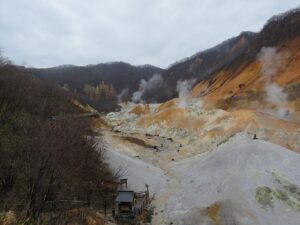
Hokkaido’s most famous onsen town, built around Jigokudani (Hell Valley) — a volcanic crater spewing steam, boiling water, and sulphur fumes. The town has 11 different water types, more than almost anywhere in Japan. Hotels pipe different mineral waters to their baths, so you can experience multiple water chemistries in a single stay.
The main public bath, Dai-ichi Takimotokan, has over 30 pools across multiple floors with different temperatures and mineral compositions. Day-use entry costs around 2,000 yen — expensive by onsen standards but the scale justifies it.
Full details in our Noboribetsu onsen guide.
Getting there: 1.5 hours from Sapporo by JR + bus, or 1 hour 20 minutes by car. Day trip doable.
2. Jozankei Onsen — Easiest from Sapporo
Only 45 minutes from central Sapporo by bus, Jozankei sits in a river gorge that turns spectacular in autumn (October). The hot springs here are sodium chloride — clear water that leaves your skin smooth. Multiple ryokans and hotels offer day-use bathing from 500 yen.
In autumn, the illumination event lights the gorge at night. In winter, snow piles on the rocks while you soak in outdoor baths. Any season works, but autumn is when Jozankei earns its reputation.
Full details in our Jozankei guide.
Getting there: Route 12 bus from Sapporo Station (45 minutes, 800 yen). The easiest onsen day trip from Sapporo.
3. Toyako Onsen — Lake Views and Fireworks
On the shore of a volcanic caldera lake with an active volcano (Mt. Usu) as a backdrop. The outdoor baths at lakeside hotels overlook the water, and from April through October, fireworks launch from boats on the lake every night at 20:45. Soaking in hot spring water while watching fireworks over a volcanic lake is hard to top.
Full details in our Lake Toya guide.
Getting there: 2 hours from Sapporo by car or train + bus. Day trip possible but overnight recommended for the fireworks.
4. Yunokawa Onsen (Hakodate) — Ocean and Monkeys
Hakodate’s hot spring district sits on the coast with Pacific Ocean views. The main attraction beyond the baths: the Yunokawa Tropical Botanical Garden where Japanese macaques bathe in an outdoor hot spring pool in winter. Watching monkeys soak in onsen while you stand in the cold outside is an oddly compelling experience.
Convenient as a last stop before Hakodate Airport (10 minutes away). See our Hakodate hotel guide for Yunokawa accommodation.
Getting there: Streetcar from Hakodate Station (30 minutes) or 10 minutes from Hakodate Airport.
5. Akanko Onsen — Lakeside and Ainu Culture
On the shore of Lake Akan in eastern Hokkaido, combined with the Ainu Kotan cultural village. The onsen water is simple thermal — clear and mild — but the setting on a volcanic lake with mountain views is beautiful. Several large resort hotels and smaller ryokans line the lakefront.
The combination of onsen, Ainu culture, and the pristine lake environment makes this worth the journey to eastern Hokkaido. See our eastern Hokkaido guide.
Getting there: 1.5 hours from Kushiro by car, 4+ hours from Sapporo. Not a day trip.
6. Sounkyo Onsen — Gorge Scenery
Deep in the Daisetsuzan mountains, Sounkyo sits at the base of a dramatic gorge with 100-metre columnar cliffs on both sides. The onsen town is small — a handful of hotels — but the combination of gorge scenery and mountain hot springs is striking. In winter, the Ice Festival (January-March) creates illuminated ice structures in the gorge.
Getting there: 3 hours from Sapporo by car, or 2 hours from Asahikawa. Technically a long day trip but better as an overnight.
7. Tokachigawa Onsen — The Unusual One
Unlike every other onsen on this list, Tokachigawa’s water comes not from volcanic activity but from ancient plant matter. The “moor” hot spring water is brown-tinted and rich in humic acids — similar to peat bogs in northern Europe. The water is reputed to be excellent for skin, and the experience of bathing in dark, silky water is unlike any other onsen in Japan.
Getting there: 20 minutes from Obihiro by car. On the route between Kushiro and Sapporo (see our 10-day itinerary).
The Quiet Five
8. Kawayu Onsen — Strongest Water
In the Akan-Mashu National Park, Kawayu has strongly acidic sulphur water that is genuinely therapeutic (and genuinely smelly). The town has an old-fashioned, undiscovered feel. Public baths cost as little as 200 yen. If you want the medicinal onsen experience rather than the resort experience, this is it.
Getting there: 2.5 hours from Abashiri, 1.5 hours from Kushiro by car.
9. Lake Shikotsu Onsen — Closest to the Airport
Only 50 minutes from New Chitose Airport, Lake Shikotsu is a caldera lake with crystal-clear water and onsen hotels along its shore. Practical for a last soak before flying out. The lake itself is one of the clearest in Japan and freezes only partially in winter.
Getting there: 50 minutes from New Chitose Airport, 1 hour from Sapporo by car. Bus service available.
10. Niseko Area Onsen — Post-Ski Soaking
Several small onsen dot the Niseko area, most used by skiers and snowboarders after a day on the mountain. Niseko Goshiki Onsen and Yugokorotei are the most popular. The combination of powder skiing followed by outdoor hot springs is one of the defining Hokkaido winter experiences.
See our Niseko guide for hotels with onsen.
11. Fukiage Hot Spring — The Wild One (Free)
A natural outdoor hot spring in the mountains near Kamifurano, completely free and open 24 hours. No building, no changing room (a basic shelter exists), no admission fee. You undress by the side of a mountain river, step into a rock pool fed by a hot spring, and sit in water surrounded by forest. In winter, snow covers everything except the steaming pool.
This is the raw onsen experience — no infrastructure, no rules (tattoos irrelevant), no comfort beyond the water itself. Bring your own towel. Not suitable for anyone who wants privacy.
Getting there: Car only. 30 minutes from Kamifurano on a forest road.
12. Kotan Onsen (Lake Kussharo) — Free Lakeside Soak
Free outdoor pools on the shore of Lake Kussharo, the largest caldera lake in Japan. Hot spring water bubbles up through the lakeside gravel, and the pools are maintained by locals. In winter, the hot springs keep patches of shoreline ice-free, and whooper swans gather at these warm spots — you soak in hot water watching swans on a frozen lake.
Mixed bathing. Very basic (a rock wall provides minimal privacy). The experience makes up for the lack of facilities.
Getting there: Car only, on the shore of Lake Kussharo in eastern Hokkaido.
How to Choose
- Day trip from Sapporo: Jozankei (easiest), Noboribetsu (most dramatic), Shikotsuko (closest to airport)
- Best for couples: Toyako (lake + fireworks), Jozankei (autumn), ryokans with private baths anywhere
- Best for families: Noboribetsu (variety of pools), Yunokawa (monkeys)
- Best for adventurous types: Fukiage (wild, free), Kotan (lakeside, free), Kawayu (strongest water)
- Best after skiing: Niseko area, Furano area
- Most unique water: Tokachigawa (moor/peat), Kawayu (strong acid)
For hotel picks at each location, see our guides: Sapporo, Hakodate, Niseko, Kitami. For onsen etiquette: the rules nobody tells you. For tattoo policies: tattoo-friendly onsen in Hokkaido.